

Why You Need Product Data for Cross-Sell & Upsell Motions
Upsell and cross-sell are now the dominant growth drivers for mature B2B software companies, but most teams still rely on static CRM data and calendar-based outreach to drive expansion. True expansion depends on readiness, and the signals that indicate readiness live inside the data warehouse in the form of real product usage, adoption patterns, and consumption thresholds. When this data is reduced to dashboards or a few Salesforce fields, teams are forced to guess, leading to mistimed outreach, inflated pipeline, and suppressed expansion. Embedding product data directly into marketing automation turns expansion into a predictable lifecycle motion, aligning sales, marketing, and customer success around the same real-time signals.

Introduction
For maturing B2B enterprises, teams are increasingly feeling the importance of expanding revenue through the upsell/cross-sell motion. Almost 40% of ARR for late-stage B2B software companies comes from expansion revenue. Leadership may make aggressive changes to deploy a new product suite or suddenly realize that they haven’t prioritized lifecycle marketing properly. Marketing motions to support this can’t be deployed solely off of CRM data. You’ll need to activate your data warehouse to unlock critical insights and reach out to customers at the right time.
Traditionally, teams have tried to use a reverse ETL, in-house data tools, or a CEP to power marketing automation through warehouse data. This leads to fragmentation, tool sprawl, missing leads, and general data chaos. New-age platforms like Conversion unify warehouse and revenue data to create a holistic view of the customer – making upsell/cross-sell motions effortless. Let’s do a deep dive on why product data is essential to your marketing automation platform if lifecycle motions are on your radar.
What data lives inside your data warehouse
Data warehouses seem scary to the non-technical user. Typically siloed in engineering teams, it’s rare that business teams ever interface with the warehouse. In reality, they are a critical component of any fast-growing enterprise that has crucial insights into customer data. Warehouses store information such as:
- An entire database of all users of your software
- Records of which products are used by which contacts and companies
- Product event logs that record millions of actions every day
- Logins
- Teammate Invites
- Feature Usages
- Page Views
- Transformations of data to create simplified variables and data fields (Typically executed by a data engineering or analytics team)
- Ex. Turning complex feature usage into an “Account Health Score"
This is just a peek into your warehouse. They are made up of thousands of tables, all of which relate to each other and store valuable information.
Guessing Games Are Killing Pipeline
Typical B2B SaaS orgs do a “vibes-based” upsell/cross-sell motion. AEs are instructed to “reach out when it feels right” or “reach out every month” which ends up being ill-timed or spammy. Marketing is instructed to throw new products in customers faces on a regular cadence. “They won’t churn! They’re locked into a year-long contract.” This is not an expansion strategy or lifecycle motion. It’s a glorified (and randomized) calendar. On top of this you’re slowly losing credibility with your customer base, who believe you don’t understand their business fundamentally.
The guessing game approach is losing you real revenue every month. Pipeline becomes inflated with low-quality opportunities while high-probability expansion moments slip through the cracks. Meanwhile, leadership may not immediately feel the damage. Contracts are still active. Revenue hasn’t churned. But what’s happening underneath the surface is more dangerous: expansion potential is decaying. Accounts that could have grown naturally stall. Advocates become neutral. Neutral customers become price-sensitive at renewal. What looks like “stable ARR” is often suppressed expansion.
Expansion Is About Readiness, Not Reach
One of the most common mistakes teams make is treating upsell and cross-sell like demand generation. They expand audiences, increase message volume, and optimize for reach, assuming that more exposure will produce more expansion. In reality, expansion depends far less on volume and far more on readiness. No matter how many times someone gets an email for an expansion opportunity, they won’t budge until the business as a unit is ready to purchase.
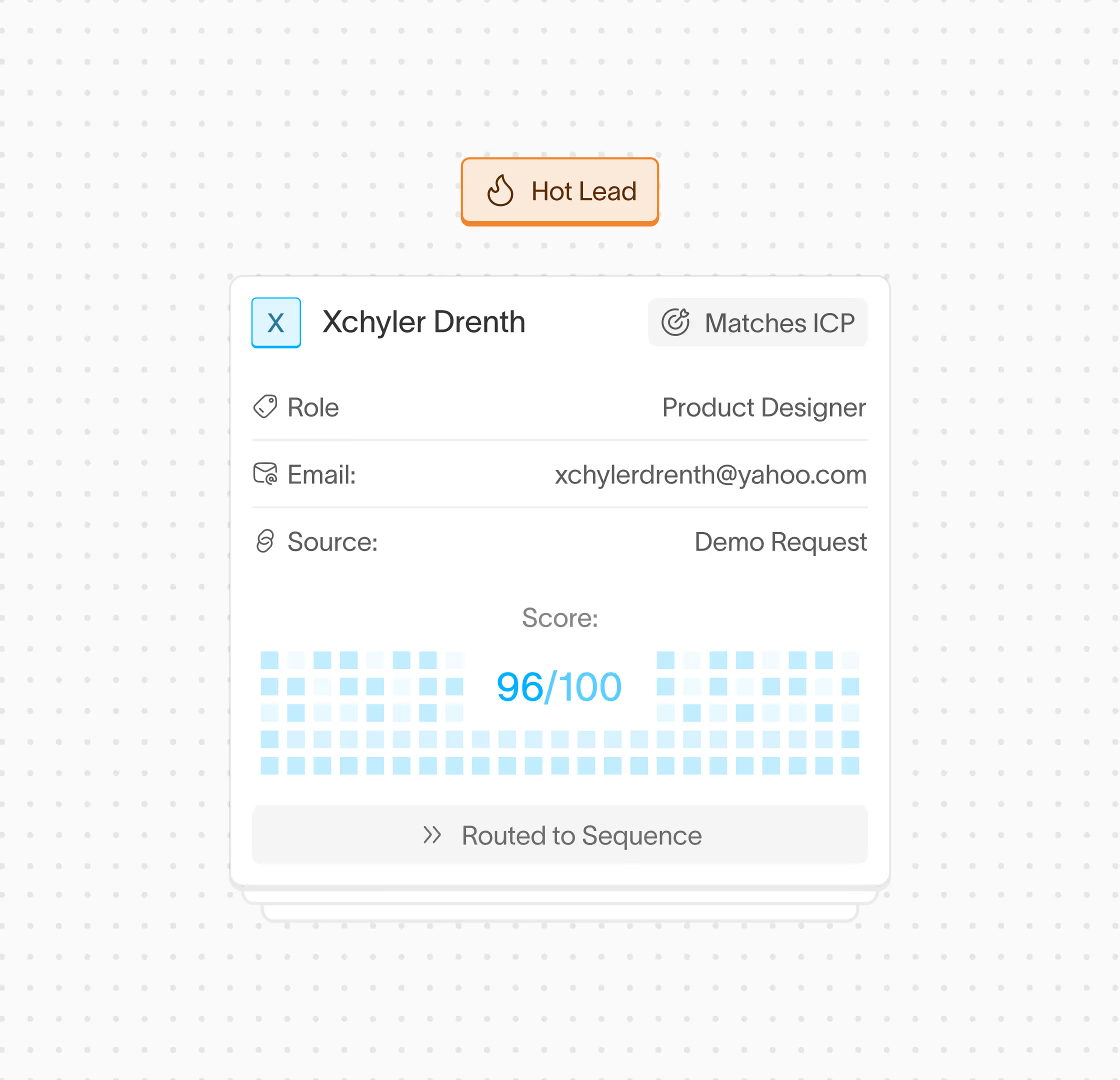
Readiness shows up in subtle ways. Buyers won’t explicitly knock on your door to tell you that they want to buy a new product or need more AI credits on their existing product. The signals for readiness live deep inside your data warehouse. Is someone > 90% of their limit on AI credits? Has an account crossed 10 total users in the past 2 weeks? These are potential signs that a contact or account is gearing up for a potential upsell or cross-sell. It’s now on sales and marketing alignment to act upon this signal and target the buyer through hyper-personalized automation.
If a marketing automation platform cannot understand how customers are using the product, it has no reliable way to determine when expansion is appropriate. As a result, teams either move too early, risking irrelevance and losing trust, or too late, missing the moment altogether.
Why Static Fields Fall Short
You might be wondering – “I thought our data team added some product data to Salesforce”. In most cases, these are static fields that don’t reflect the complexity of the buyer account and their usage. It may have basic information such as “Uses XYZ products” or “Tier = Enterprise” but it certainly does not contain in-depth feature usage, events, complex objects, etc.
Your warehouse is a living breathing universe of infinite data. Using it for a few custom fields is one thing but the real value comes from the ability to record events, attributes for those events, custom data objects, and attributes that can relate a contact or company to that object. Once you have a data setup that contains real-time information such as “Used X feature in the last 30d” or “Approaching seat limit”, you’ll be able to run powerful up-sell/cross-sell campaigns to hyper-complex audiences.
Why Product Data Belongs Inside Marketing Automation
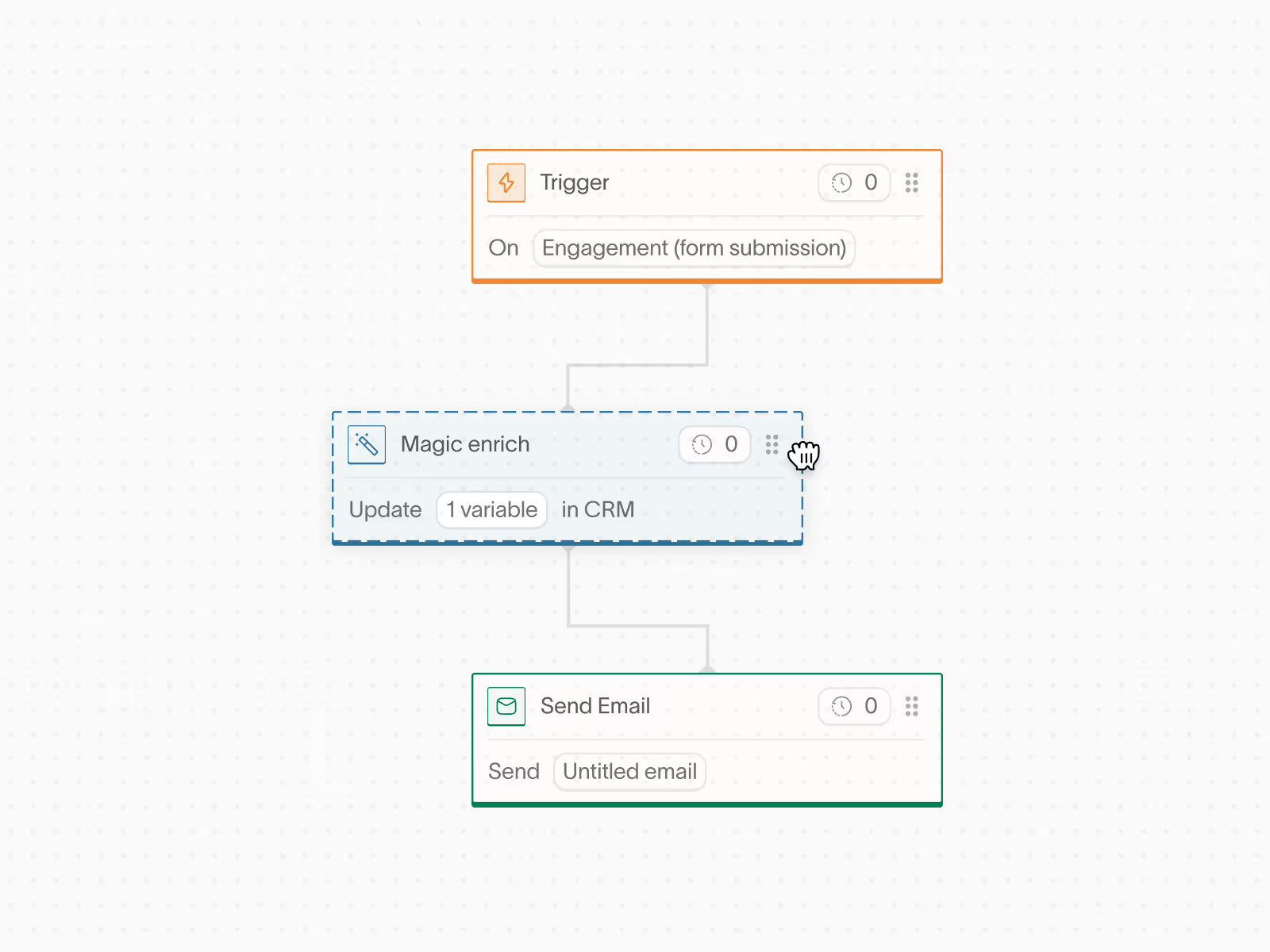
For upsell and cross-sell to work at scale, product data must be more than something teams analyze in dashboards. It must be directly actionable. When product data lives inside the marketing automation platform itself, expansion logic becomes automated rather than manual. Messaging stays tightly aligned with real usage. Whether it’s creating smart automations to send ads and notify sales the moment a key signal is achieved within an account or inserting custom warehouse variables into dynamic emails, the data warehouse enables GTM-wide alignment on lifecycle marketing. Sales, marketing, and customer success operate off the same signals instead of competing interpretations. Most importantly, revenue expansion becomes predictable and achievable rather than opportunistic and serendipitous.
More from the Wayfinder

Turn Every Form Fill-Out Into Your Next Customer
Trigger personalized emails and actions based on real-time behavior, not static lists.

.png)