


Historically, MOps teams have built campaigns, workflows, and complicated routing logic to get the right messaging to every customer. More than half their day is spent in the monotony of figuring out why something happened, how it runs, and fixing bugs.
There is significant customer ROI still to be uncovered with what we call long-horizon agents: an individual agent that sits on a contact and uses all of the context relevant to that contact to make the next best decision. AI is now capable enough to act the way an ABM marketer or a sales rep would if they were dedicated to that one contact, deciding the best strategy for it.
Today, we’re introducing Orchestrator to drive customer outcomes all the way from the first email through to a closed-won deal. Orchestrator coordinates the entire customer journey from front to end to optimize toward a specific goal across a select segment of contacts.
Orchestrator fundamentally changes how MOps teams build campaigns. They can build campaigns at scale, then let Orchestrator decide what matters most for each individual contact based on the context we store on each of them. MOps teams define the objective once, the agent works toward it on every contact by choosing the next best action from the ones they’ve allowed, and over time, between shared memory, validation, and prompting, Orchestrator continues to improve the customer experience.
With Orchestrator, teams can:
- Drive unique customer journeys end to end, with deep orchestration across every touchpoint that matters to customers
- Take the next action proactively across emails, landing pages, ad audiences, and campaigns
- Recursively improve over time to deliver the best customer outcomes possible, with native attribution reporting and success tracking
- Work with the workflows and campaigns they already run
- Follow the guardrails they set, with complete auditability of every decision
Drive unique customer journeys end to end
The first thing you do is select a group of contacts. Those contacts are then given a conversion goal, something for the agent to optimize toward, like getting evaluators into a technical deep dive or trial users to their first workflow.
A long-horizon agent is placed on each of those contacts with the full context and memory in the entire database, pulled from Salesforce, Gong, your data warehouse, and every other system you’ve connected. It brings in all this context, memory, and the specific instructions written by users to help optimize that customer’s journey. For example, if a prospect has two emails being delivered in a day and Orchestrator sees that the contact is likely to click on only one, it will reschedule the additional email. If a contact is at a certain stage in Salesforce and the content being sent doesn’t match that stage, it will automatically update and send the right content based on the stage and evaluation criteria they’re in, with the context that is relevant for that deal.
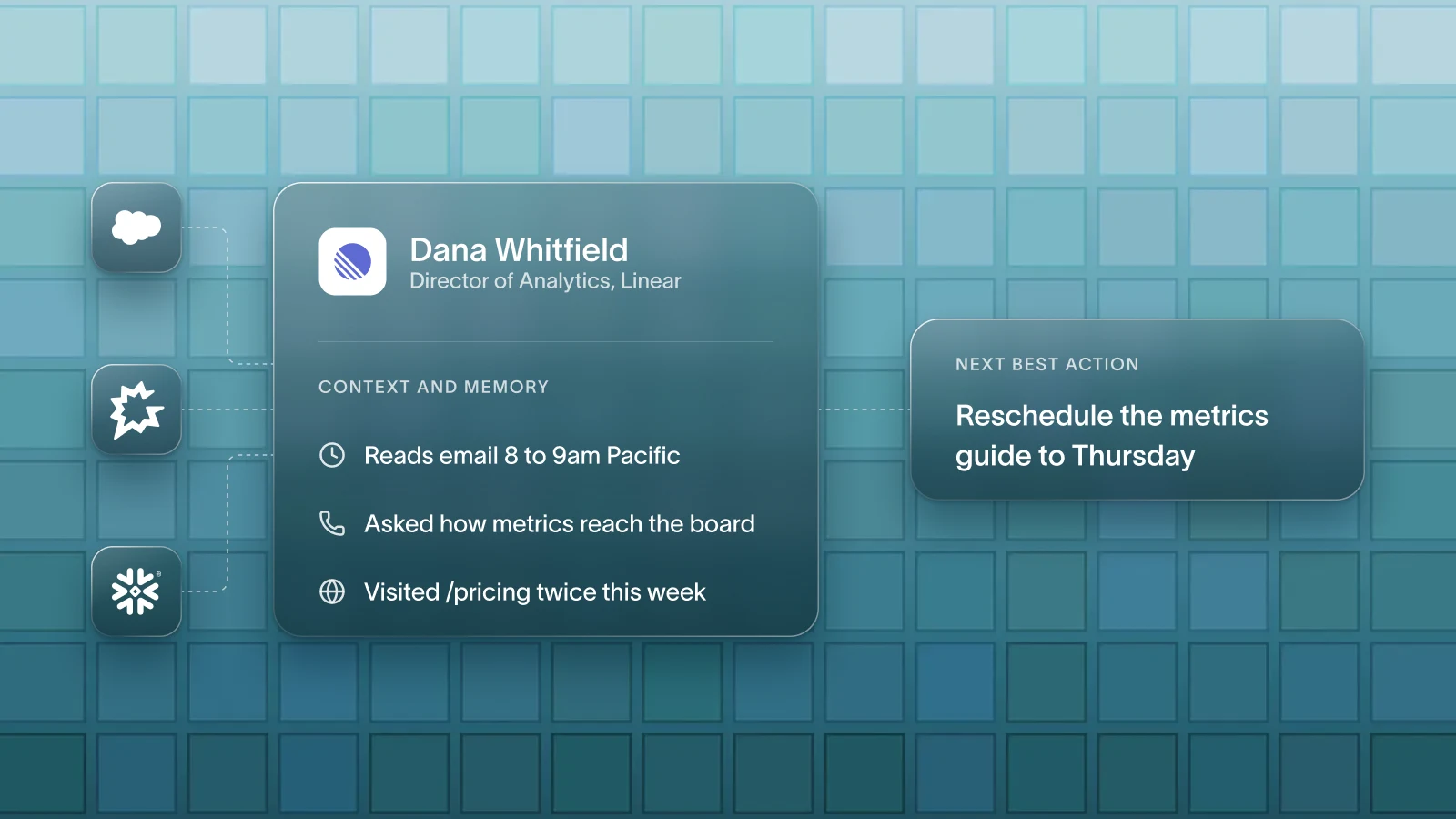
Often this has to be orchestrated across an entire account, so Orchestrator also understands the complete history of a contact, the account, the opportunities, and the custom objects tied to that account. It takes all of that into account when deciding the next best action. For example, if a deal is moved into evaluation, it might build a one-to-one ABM landing page and ad group for the entire buying group and send it over three days. If a deal is in negotiation with an AE or in procurement, it might prevent sending the traditional marketing emails that you would expect. If an account gets a new executive, it will alert the associated account owner of the change.
Personalize at scale
Historically, one of the hardest parts of building custom journeys is that the context you need is already there, but the actual work of personalizing everything is very difficult. With Orchestrator, an agent can now individually personalize every asset and every landing page, bringing in context from across the entire account to make sure every touchpoint is customized for that person.
The process for marketers is still fundamentally the same. You build the campaign and the assets that matter to you, but Orchestrator can now bring in the associated context to change the email copy for every contact before it actually sends. All of this remains visible to the marketer, who can decide whether to review the changes first, edit them, or send as is, with a complete record of what changed.
Recursively improve
Every time a touchpoint happens with a customer, the agent logs that decision, updates its memory, and takes it into account next time. In practice, across the entire group of contacts, Orchestrator keeps learning what drives the most meaningful customer outcomes. About once a week it reviews how its decisions landed across the audience and updates its own instructions.
Working with Mosaic and all the native campaign infrastructure we’ve built, it has a deep understanding of what’s actually driving pipeline.
Work with your existing workflows and campaigns
Orchestrator already works with the infrastructure and MAP that is most familiar to customers. It works across the blasts, workflows, and campaigns you already run, without any need for a complete migration or rebuilding anything.
Every time an action is expected to be taken via the traditional path, such as sending a blast or reaching a workflow step, it now goes into a universal queue. Orchestrator schedules across that queue with the following:
- Delivery windows. Each email Orchestrator sends has a delivery window, which provides clear guardrails for when the email should be sent by. For example, if you have a conference coming up in a month and you want to make sure the invite goes out this week, it will take that into account when designing the journey.
- Required emails. For things such as product launches, one-time events, or time-bound restrictions, you can mark an email as required and it will automatically get sent no matter what.
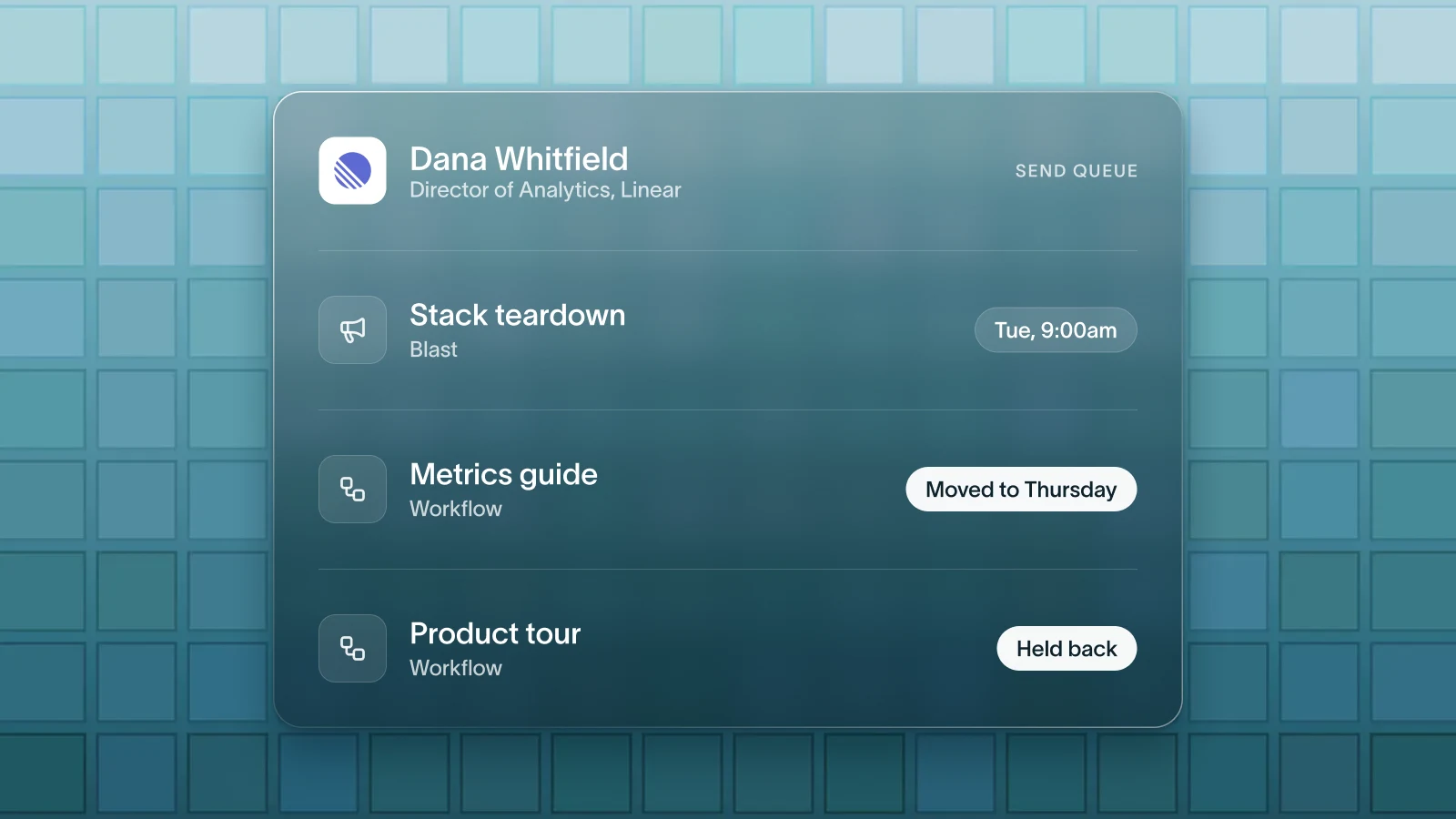
Because a MAP is the source of truth for marketing teams, all of this data is always stored natively in Conversion, and it syncs automatically to the campaigns in Conversion, Salesforce, and the ads platforms you’re most familiar with.
Built with guardrails and complete auditability
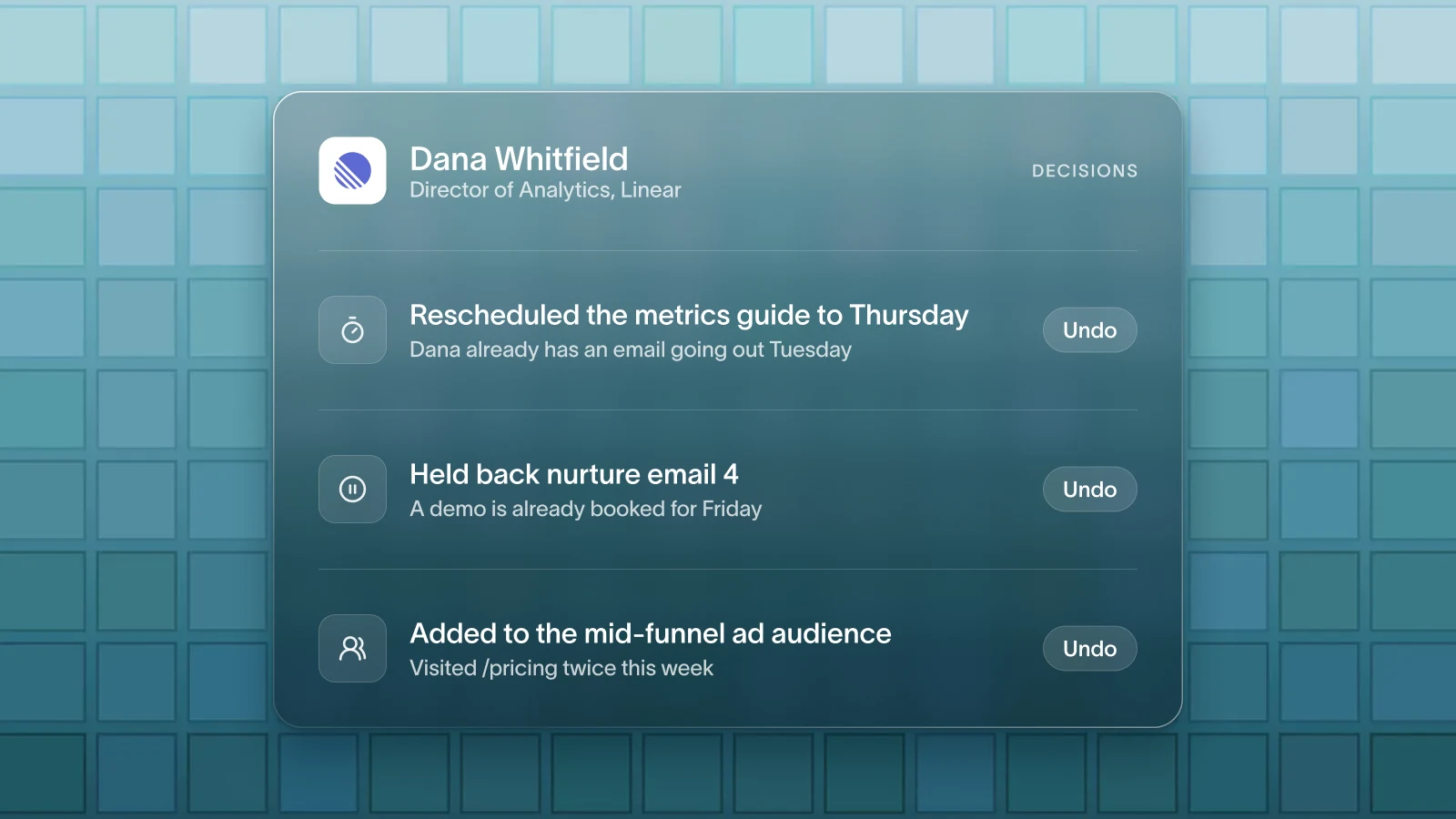
Marketers have complete ownership and understanding of what Orchestrator is doing at all times, with a complete decision log, audit trace, and permissions.
Users can define the list of actions and tool calls that Orchestrator can take, and manually decide what it is and is not allowed to do. Existing settings like communication limits, consent, and suppression lists are always enforced on every interaction.
Decisions are logged with complete reasoning, both on the contact and across the entire audience. There you can see a complete log of every decision made and why it was made, and revert it if needed. Changes made also reflect back into memory and context, so Orchestrator can recursively improve.
Get started
Orchestrator is available in early access today for Conversion customers. To turn it on, pick an audience, write its goal, choose the actions Orchestrator can take, and set how often each person should hear from you.
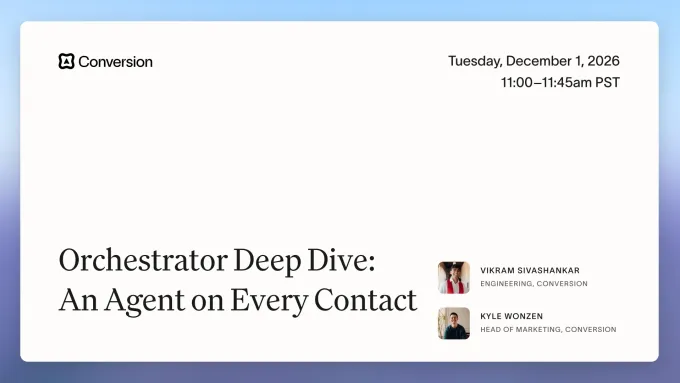
See how it works, or join Vikram and Kyle for a live deep dive on Tuesday, December 1 at 11:00am PT. If you aren’t on Conversion yet, book a demo and bring a target account list.
Neil