Retire Eloqua without a six-month services project
Agents read your Campaign Canvas, CDOs, and field merges, then rebuild them in Conversion. Your strategist QAs every component while Eloqua keeps sending. Average timeline: four weeks, not two quarters.
Trusted by teams that made the switch










4 wk
Average migration timeline
1-2 hr
Per week from your team
0
Gap in campaign execution
Your Eloqua vocabulary, mapped
Eloqua's depth is why leaving it usually means a long consulting engagement. Agents change that math. Every concept your team relies on has a direct equivalent.
Workflows & Campaigns
Multi-step orchestration with branching, delays, and AI decision nodes, tied to Salesforce Campaigns.
Data workflows
Normalization, routing, and lifecycle programs rebuilt with the same workflow primitives as everything else.
First-class custom objects
Full relationship support, workflow triggers, Liquid access, and segmentation on any object.
Liquid templating
Live CRM and warehouse fields with conditional blocks and loops in an industry-standard language.
Segments
A visual statement builder with deeply nested conditions across any object.
Scoring models
Rules-based models plus AI agents that score on product and account signals.
Built-in reporting
Campaign performance tied to pipeline and revenue, without a separate BI layer to license and learn.
What agents do with your Eloqua instance
Eloqua instances carry a decade of canvases, CDOs, and processing steps. Agents read the whole estate in days, and your strategist decides what moves, what consolidates, and what retires.
Meet the agentsRead every canvas
Agents map each Campaign Canvas and Program Canvas, including decision steps and wait steps, and translate them into workflows for QA.
Migrate CDOs with their relationships
Custom Data Objects become first-class custom objects with real relationships, triggers, and Liquid access instead of lookup workarounds.
Convert field merges
Field merges and dynamic content rules are rebuilt in Liquid with live field references, verified against rendered output.
Eloqua stays live for the entire migration. Every component is QA'd before anything switches, and you decide when the migration is finished.
Your Eloqua build, rebuilt in a single prompt
We opened the chat, asked for this Campaign Canvas to be rebuilt in Conversion, and this is what came back. Same decision steps and wait steps, in a builder that is faster to configure and easier to debug.
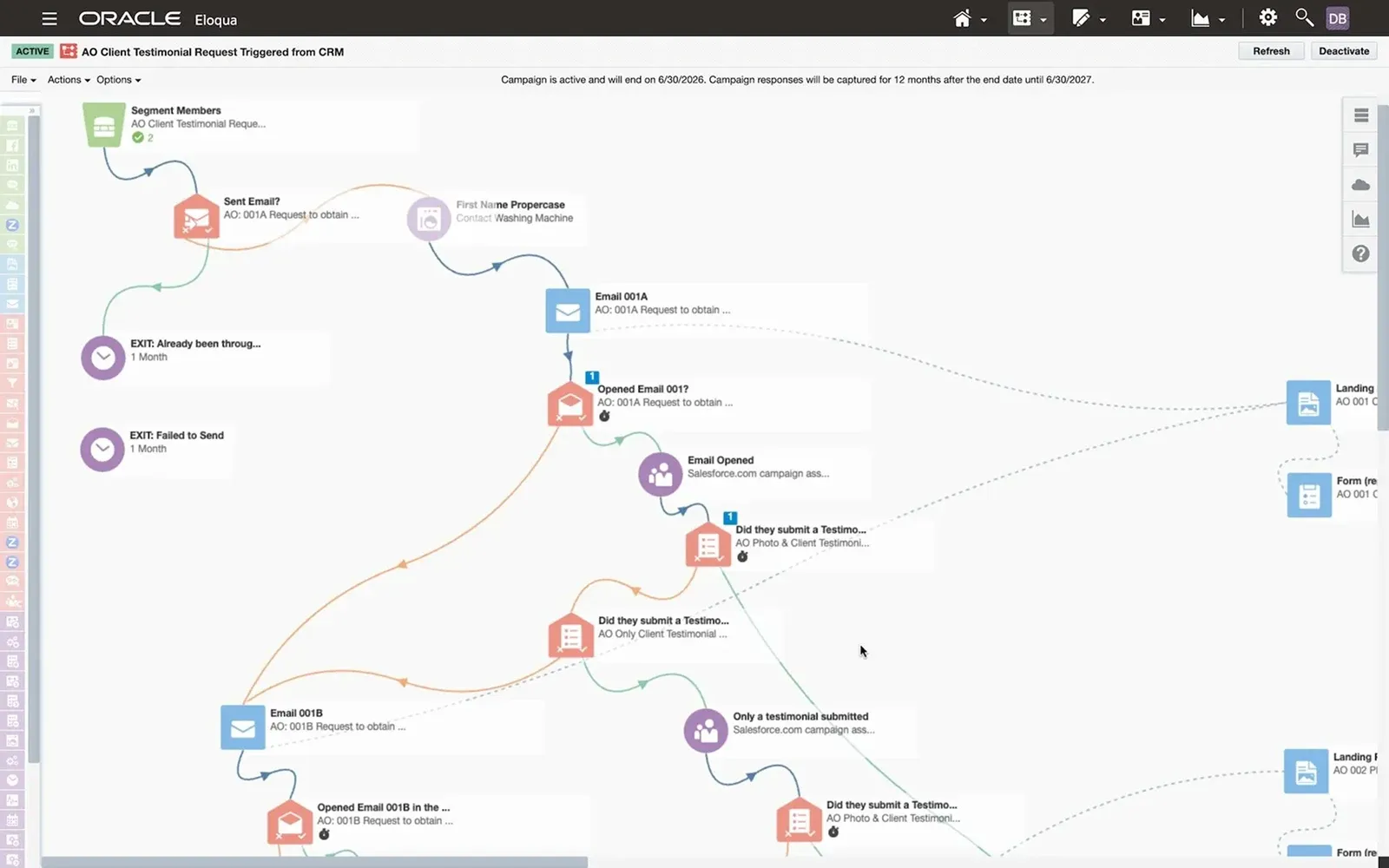
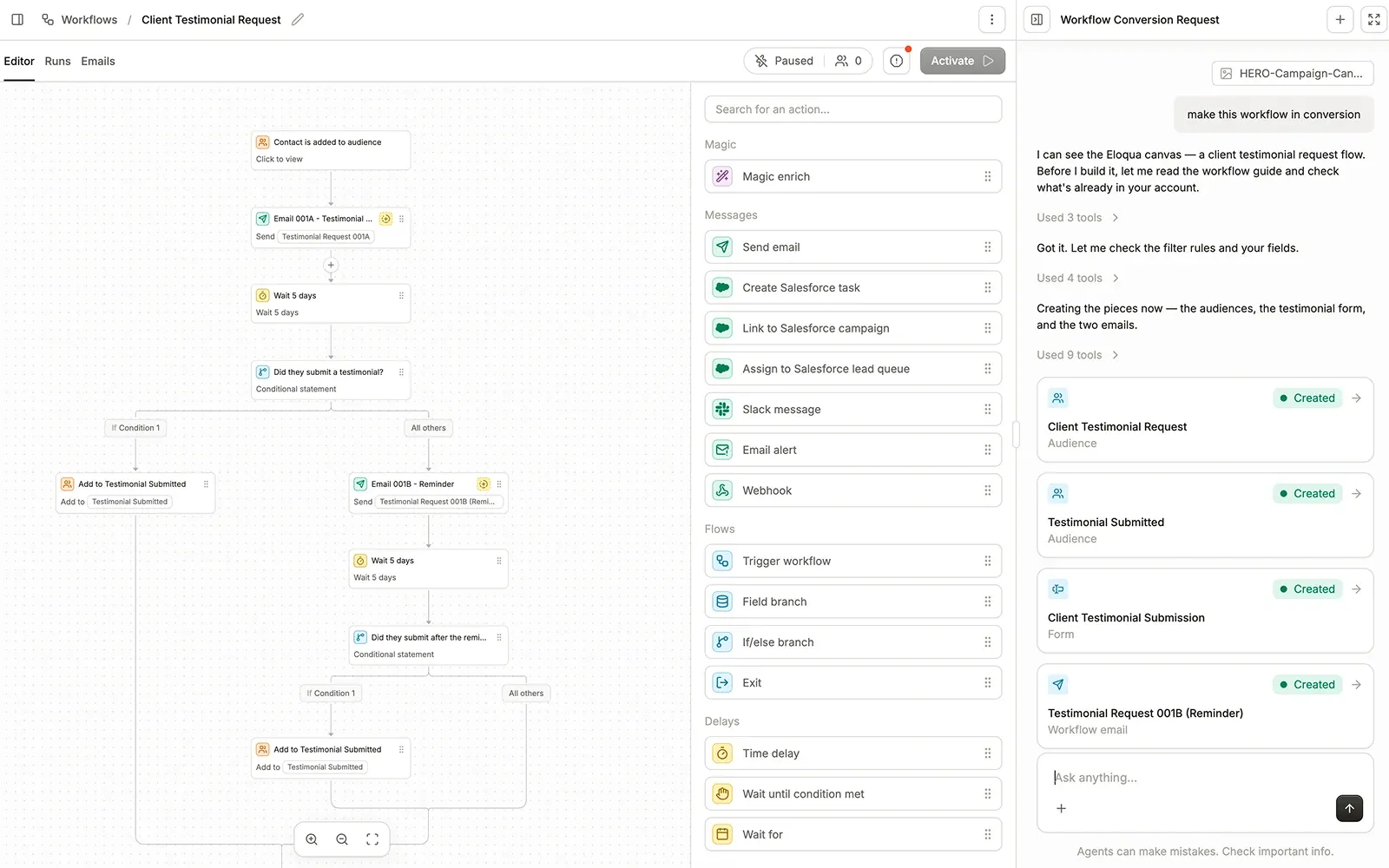
Multiply that by every program in your instance and you have the migration. Agents do the rebuilding, your strategist QAs each component, and Eloqua keeps sending until the migration is finished.
Five phases, zero downtime
The same five phases run on every migration. Agents compress the audit and rebuild from months to days, and your strategist owns the plan, the QA, and the switch itself.
Discovery & Audit
Agents crawl your current platform and map every program, scoring model, email template, integration, and routing rule in days. Your strategist reviews the map with you and flags what to rebuild, consolidate, or retire.
Migration Planning
Together, you build a phased plan with clear milestones. Your team keeps running campaigns in your current platform throughout the transition.
Data Migration & CRM Sync
Contact records, custom fields, and list structures move over with agent-run validation at every step. Salesforce sync is configured and tested alongside your existing platform before anything switches.
Program Rebuild & Testing
Agents rebuild your workflows, nurture programs, and scoring models in Conversion. Your strategist tests every component end to end against live data and signs off before it ships.
Go-Live & Optimization
Your strategist stays embedded with your team after you go live. They monitor deliverability, optimize workflows, and make sure adoption sticks.
Common questions
Everything you need to know about moving from Eloqua to Conversion.
Canvases become workflows: the same multi-step orchestration with branching, delays, and decision logic, in a builder that is faster to configure and easier to debug. Campaign membership syncs bidirectionally with Salesforce Campaigns, so attribution carries through.
Custom Data Objects migrate to first-class custom objects with full relationship support. Unlike CDO lookups, they trigger workflows directly, appear in Liquid templating, and drive segmentation alongside CRM and warehouse data.
Yes. Normalization, routing, and lifecycle programs are rebuilt with the same workflow primitives used for campaigns, so your team maintains one system instead of two canvases with different rules.
Reporting is built into Conversion and tied to pipeline and revenue by persona, segment, and lifecycle stage. There is no separate BI product to license, and no OBIEE subject areas to learn.
The average is about four weeks, with large multi-canvas instances running closer to six. Eloqua stays live for the entire parallel run and your team spends 1 to 2 hours a week reviewing and approving.
Ready to retire Eloqua?
Talk to our team about an agent-run Eloqua migration. Your instance stays live until every canvas is rebuilt, tested, and approved.