Move off Pardot, keep the Salesforce foundation
Agents rebuild your Engagement Studio programs, scoring models, and templates in Conversion, with deeper Salesforce sync than the connector ever gave you. Pardot keeps sending until the migration is finished. Average timeline: four weeks.
Trusted by teams that made the switch










4 wk
Average migration timeline
1-2 hr
Per week from your team
0
Gap in campaign execution
Your Pardot vocabulary, mapped
You chose Pardot because it lived inside Salesforce. Conversion keeps that foundation and removes the Prospect-object ceiling everything else was built on.
People
Synced Contact-first from Salesforce, with no Prospect-to-Lead mapping to reason about.
Workflows
Visual orchestration with branching, delays, conditional exits, and AI decision nodes.
Workflow triggers
Fire from form submits, field changes, product events, or any custom object update in real time.
Segments
Built visually on any CRM, warehouse, or product attribute, with no synced-field ceiling.
Liquid templating
Dynamic content with live CRM and warehouse fields in an industry-standard language.
Scoring models
Rules-based scoring and grading plus AI agents that score on product and account signals.
Native Salesforce sync
Bidirectional with Campaign membership, object writes, field-level rules, and full audit logs.
What agents do with your Pardot instance
Pardot migrations are well-trodden. Agents handle the translation from Prospect-centric to a full relational model, and your strategist verifies every piece.
Meet the agentsAudit every Engagement Studio program
Agents map each step, rule, and action across your programs and translate them into workflows for your strategist to QA.
Untangle completion actions
Completion actions and automation rules scattered across forms, files, and pages are inventoried and rebuilt as real-time workflow triggers.
Convert HML to Liquid
Handlebars Merge Language templates are rebuilt in Liquid with live field references, verified against rendered output.
Pardot stays live for the entire migration. Every component is QA'd before anything switches, and you decide when the migration is finished.
Your Pardot build, rebuilt in a single prompt
We opened the chat, asked for this Engagement Studio program to be rebuilt in Conversion, and this is what came back. Same steps and rules, now able to trigger on warehouse and product data.
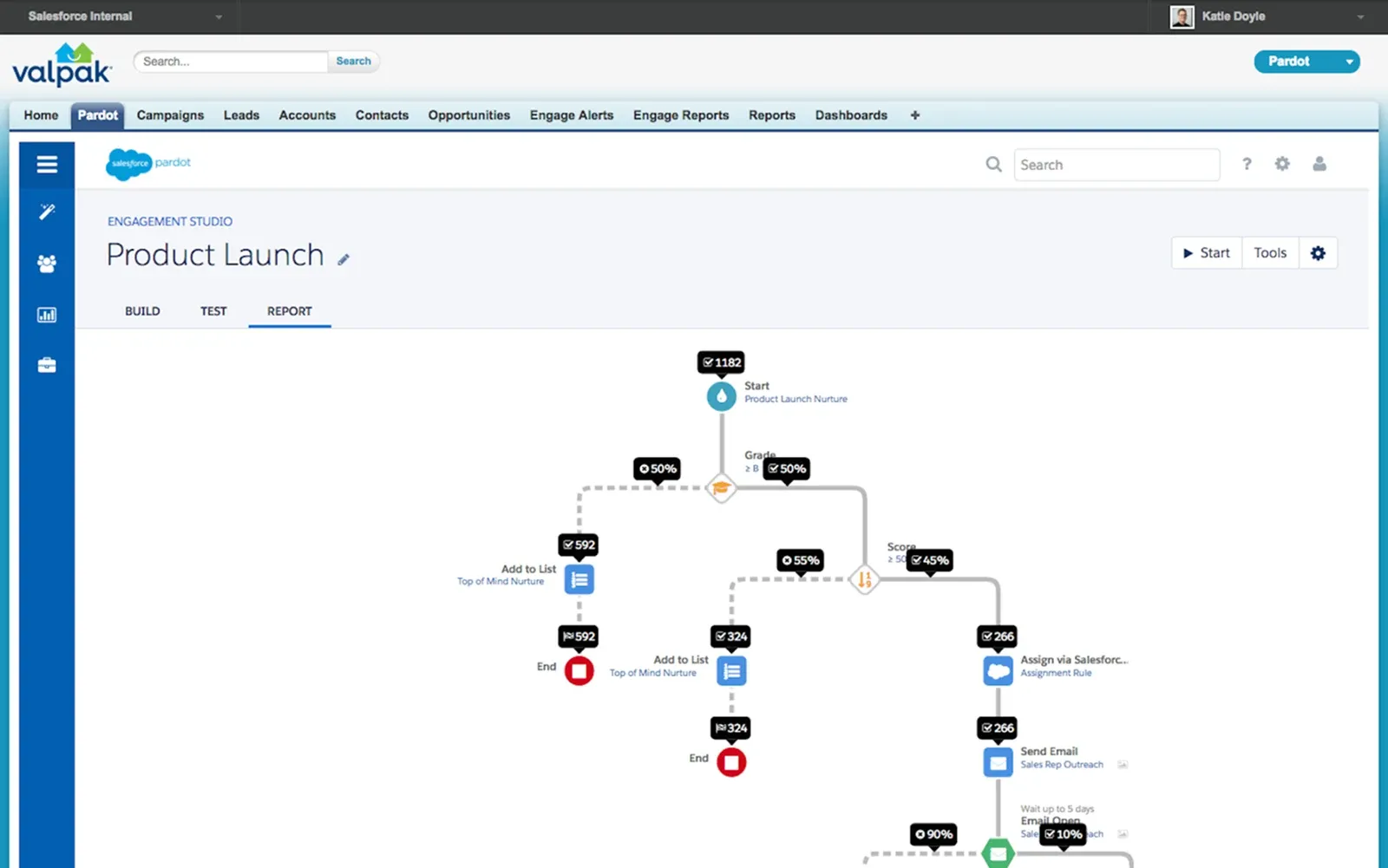
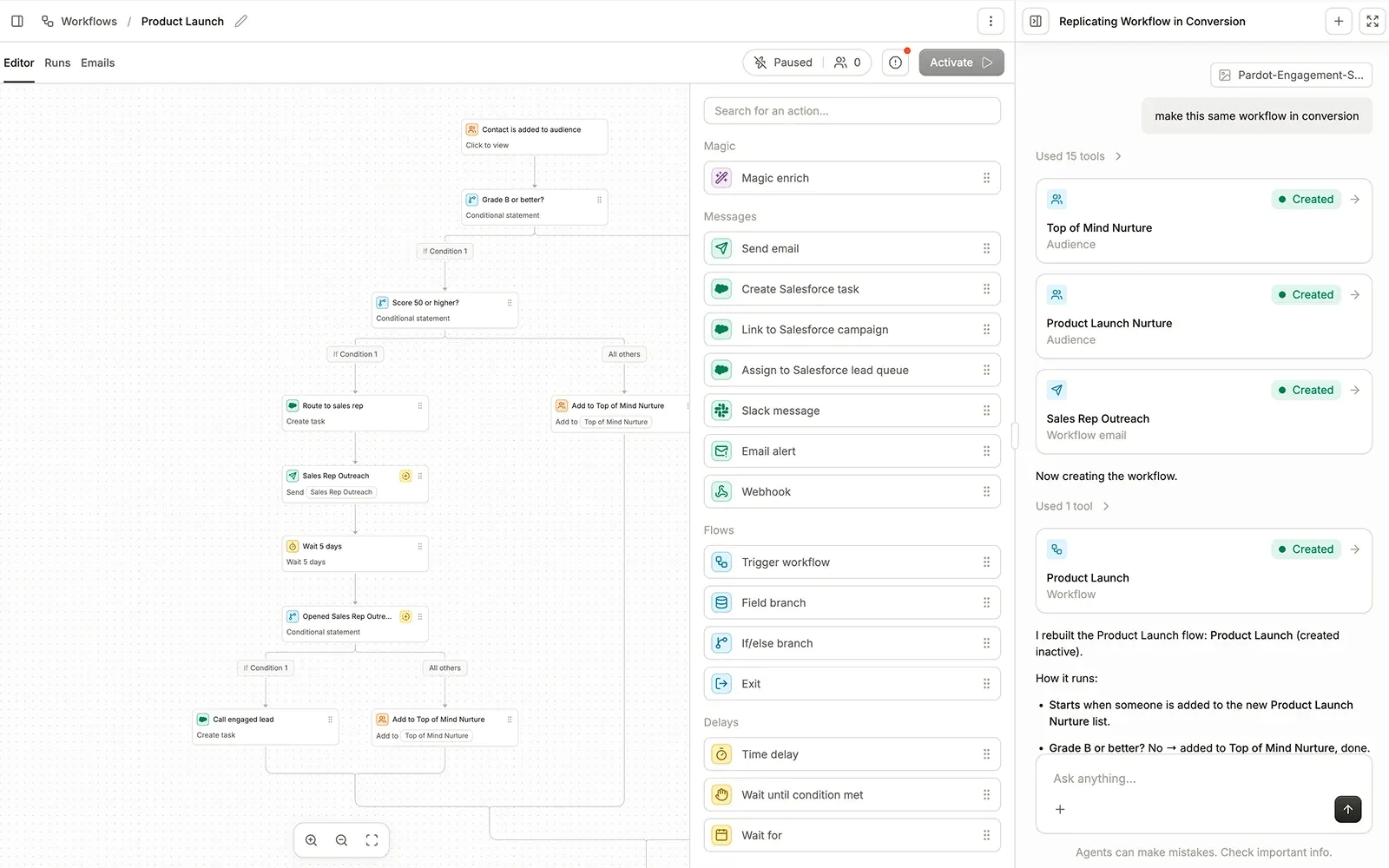
Multiply that by every program in your instance and you have the migration. Agents do the rebuilding, your strategist QAs each component, and Pardot keeps sending until the migration is finished.
Five phases, zero downtime
The same five phases run on every migration. Agents compress the audit and rebuild from months to days, and your strategist owns the plan, the QA, and the switch itself.
Discovery & Audit
Agents crawl your current platform and map every program, scoring model, email template, integration, and routing rule in days. Your strategist reviews the map with you and flags what to rebuild, consolidate, or retire.
Migration Planning
Together, you build a phased plan with clear milestones. Your team keeps running campaigns in your current platform throughout the transition.
Data Migration & CRM Sync
Contact records, custom fields, and list structures move over with agent-run validation at every step. Salesforce sync is configured and tested alongside your existing platform before anything switches.
Program Rebuild & Testing
Agents rebuild your workflows, nurture programs, and scoring models in Conversion. Your strategist tests every component end to end against live data and signs off before it ships.
Go-Live & Optimization
Your strategist stays embedded with your team after you go live. They monitor deliverability, optimize workflows, and make sure adoption sticks.
Common questions
Everything you need to know about moving from Pardot to Conversion.
Your people sync directly from Salesforce, Contact-first, with full field data and list memberships. There is no separate Prospect object to maintain and no Prospect-to-Lead mapping to reason about: Salesforce stays the source of truth and Conversion works from it natively.
Engagement Studio programs become Conversion workflows: the same visual orchestration with branching, delays, and conditional exits, plus triggers Pardot never supported, like warehouse data changes, product events, and custom object updates. Agents translate the programs and your strategist tests each one before launch.
Yes. Rules-based scoring and grading rebuild directly, and you can layer on AI agents that score using product usage and account signals rather than synced fields alone. Sales sees the same fields in Salesforce they always did.
Yes. Conversion syncs alongside Pardot for the entire parallel run. Field-level sync rules control what Conversion writes, so the two systems never fight over the same fields, and audit logs show every change.
The average is about four weeks. Your Salesforce data syncs from day one, Pardot keeps sending through the parallel run, and your team spends 1 to 2 hours a week reviewing and approving.
Outgrowing Pardot?
Talk to our team about an agent-run Pardot migration. Pardot stays live until every program is rebuilt, tested, and approved.